LAW REPAIRS
Ten criteria for evaluating the effectiveness of the law. Learn them once, apply them to every topic, and evaluation stops being the part of the response you improvise at the end of a paragraph.
“An effective law delivers justice and reflects the values and needs of society.”
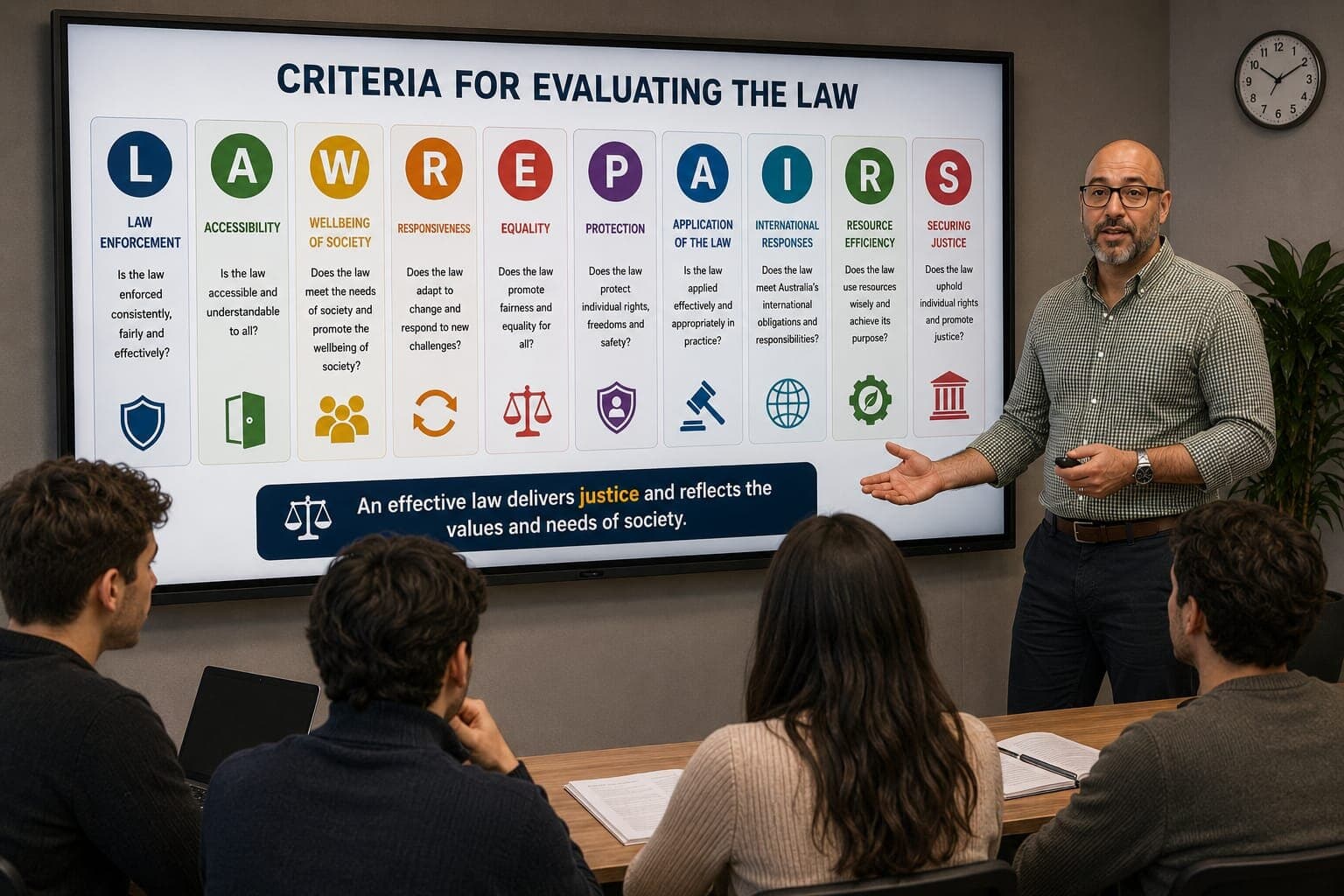
Law Enforcement
Is the law enforced consistently, fairly and effectively?
Consider resourcing, police and agency powers, discretion, compliance rates and whether enforcement reaches the people the law was written for.
Accessibility
Is the law accessible and understandable to all?
Cost, delay, legal representation, geography, language and legal literacy all determine whether a right on paper can actually be used.
Wellbeing of Society
Does the law meet the needs of society and promote its wellbeing?
Weigh community expectations, public safety and social cohesion against individual rights and freedoms.
Responsiveness
Does the law adapt to change and respond to new challenges?
Look at the speed of legislative reform, judicial development, law reform body recommendations and the pressure created by technology and media.
Equality
Does the law promote fairness and equality for all?
Consider formal equality against substantive equality, and identify groups for whom the law operates differently in practice.
Protection
Does the law protect individual rights, freedoms and safety?
Balance protective mechanisms against the rights they limit, and test whether protection is real or symbolic.
Application of the Law
Is the law applied effectively and appropriately in practice?
The gap between the law in the books and the law in action is often where the strongest evaluation sits.
International Responses
Does the law meet Australia's international obligations and responsibilities?
Treaties, conventions, ratification, incorporation into domestic law, and the limits of international enforcement.
Resource Efficiency
Does the law use resources wisely and achieve its purpose?
Cost to the state, court and agency workload, delay, and whether the outcome justifies the expenditure.
Securing Justice
Does the law uphold individual rights and promote justice?
The overall judgement: does this area of law deliver justice for victims, offenders, parties and the wider community?
Four criteria used properly beat ten listed
The mistake students make with any acronym is treating it as a checklist. A response that marches through all ten criteria in turn reads as mechanical and runs out of time.
Choose the criteria the evidence actually tests. Two well supported criteria in a paragraph, each reaching a judgement, will outscore a list every time.
In sessions we apply the framework to your own written work, on your own topics, until the judgement sentence comes automatically.
- 01State the legal point, naming the legislation or case accurately.
- 02Support it with evidence: case, statistic, media report or law reform recommendation.
- 03Select the criteria the evidence genuinely tests.
- 04Write the judgement sentence, stating how effective the law is and why.
- 05Acknowledge the trade off, which is where sophistication is demonstrated.
Bring an essay and we will evaluate it together
A 30 minute introductory session is enough to see exactly where the evaluation is missing.